
Three hundred people gathered in Tompkins Square Park last week with a single rule: no phones. The event was called Summer of Ludd. They learned to flirt in person. Practiced mending. Attended sessions on fighting data centers. No advertising online — only posters in the neighborhood, hand-placed. Only in real life.
There is something genuinely appealing about that. An afternoon in a park without a phone, fully present, talking to a stranger, is not a political statement. It’s just a good afternoon. The rage behind this movement is real. So is the thing it’s mourning.
But there is something else the festival shares with its namesake.
The original Luddites were right, too.
The First Machine-Breakers
The movement began in Nottingham in 1811 among skilled textile artisans who had spent years learning their craft. They were not, as the myth has it, simply anti-progress. They were trained workers resisting specific machinery being used to circumvent labor agreements, undercut their wages, and flood the market with inferior goods. They were right that those machines would destroy their livelihoods. That part of the prediction was entirely accurate.
They broke the frames at night in coordinated raids. The government responded by making machine-breaking a capital offense. The movement was suppressed by executions and deportation to the colonies. Industrialization proceeded exactly as the Luddites had predicted — and the people who had predicted it were gone.
History mostly mocks them. It shouldn’t. They read the situation correctly. They simply had no leverage on the outcome. The weavers who learned to operate the new power looms kept working. They didn’t get rich. But they kept their livelihoods — which is exactly what the ones burning the frames were trying to protect.
The Real Scale of the Resistance
The 300 people in Tompkins Square are not the whole story. A survey this year found that 44 percent of Gen Z workers admit to actively sabotaging their employers’ AI deployments — entering garbage data, deliberately generating poor outputs to discredit the tools, refusing to engage with mandated platforms. That is not a niche. That is nearly half a generation quietly breaking the machines at their desks, in the same year AI became the leading cause of job cuts for the first time in recorded history.
That is the actual parallel to 1811. The scale is different. The mechanism is the same. The people most directly threatened by a technological shift are deploying the only resistance available to them: friction from the inside.
It will not work for the same reason it did not work then.
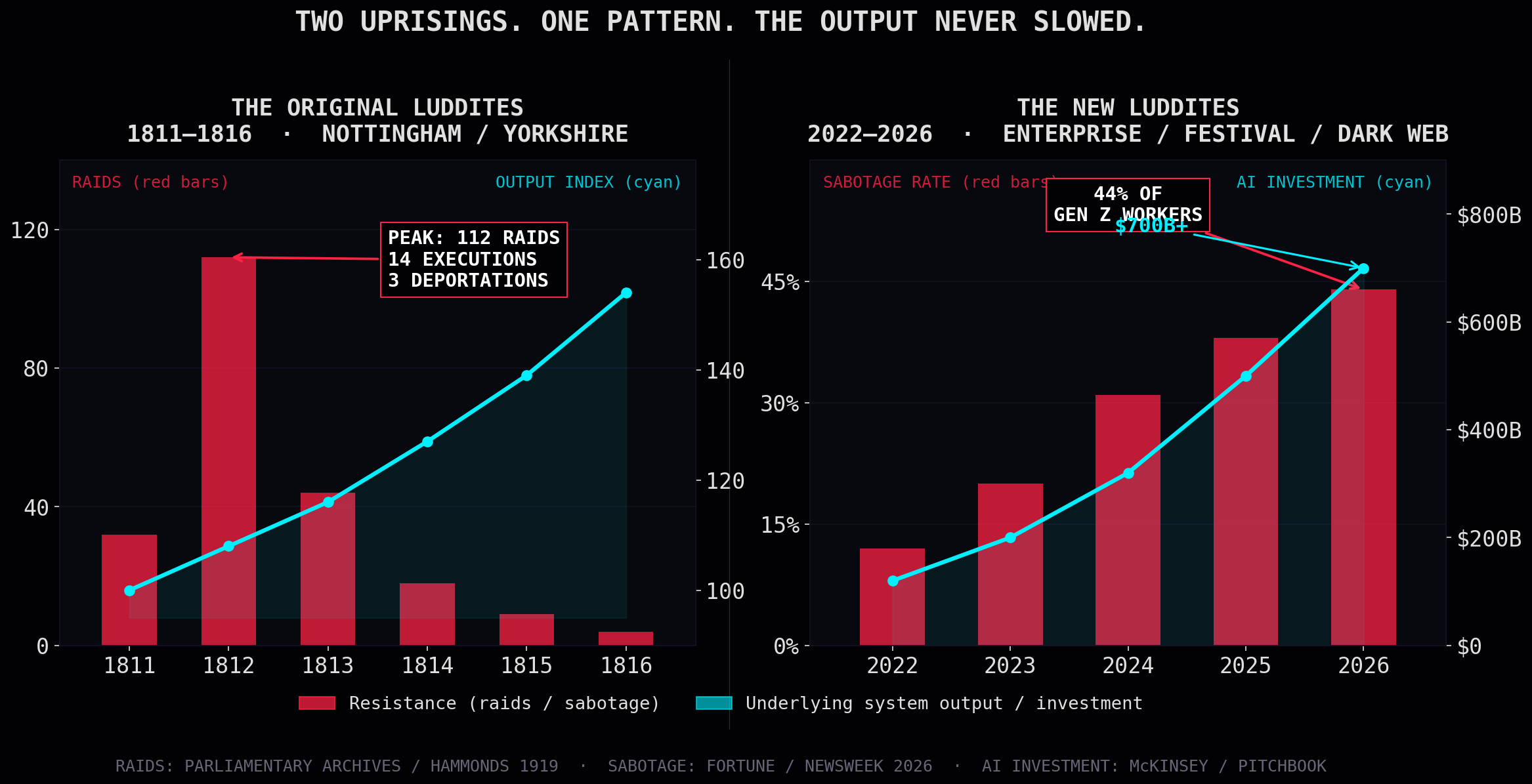
The raids peaked in 1812 and were crushed. The looms kept running. The bars on the right are doing the same thing, at a different scale.
The Diagnosis Is Correct
The harms Gen Z is reacting to are real.
Social media has degraded human attention — not metaphorically, but measurably and by design. The platforms were built for engagement, which means built for compulsive return, which means built against the kind of sustained presence that makes an afternoon in a park worth having. A 2025 Pew study found 48 percent of teens say social media has negative effects on people their age — nearly double the proportion who said so in 2022. Half a generation is describing its own environment accurately.
The job threat is real. AI was the leading cause of layoffs in March 2026. Entry-level roles have contracted sharply. The people at the bottom of the labor market — with the least savings, the least flexibility, the least ability to retrain on their own time — are absorbing the displacement first.
The cultural loss is real. A generated image is not a photograph. A language model reply is not a letter. The substitution of produced content for made content is a genuine degradation of something that carried meaning.
The rage is proportionate. The diagnosis is sound.
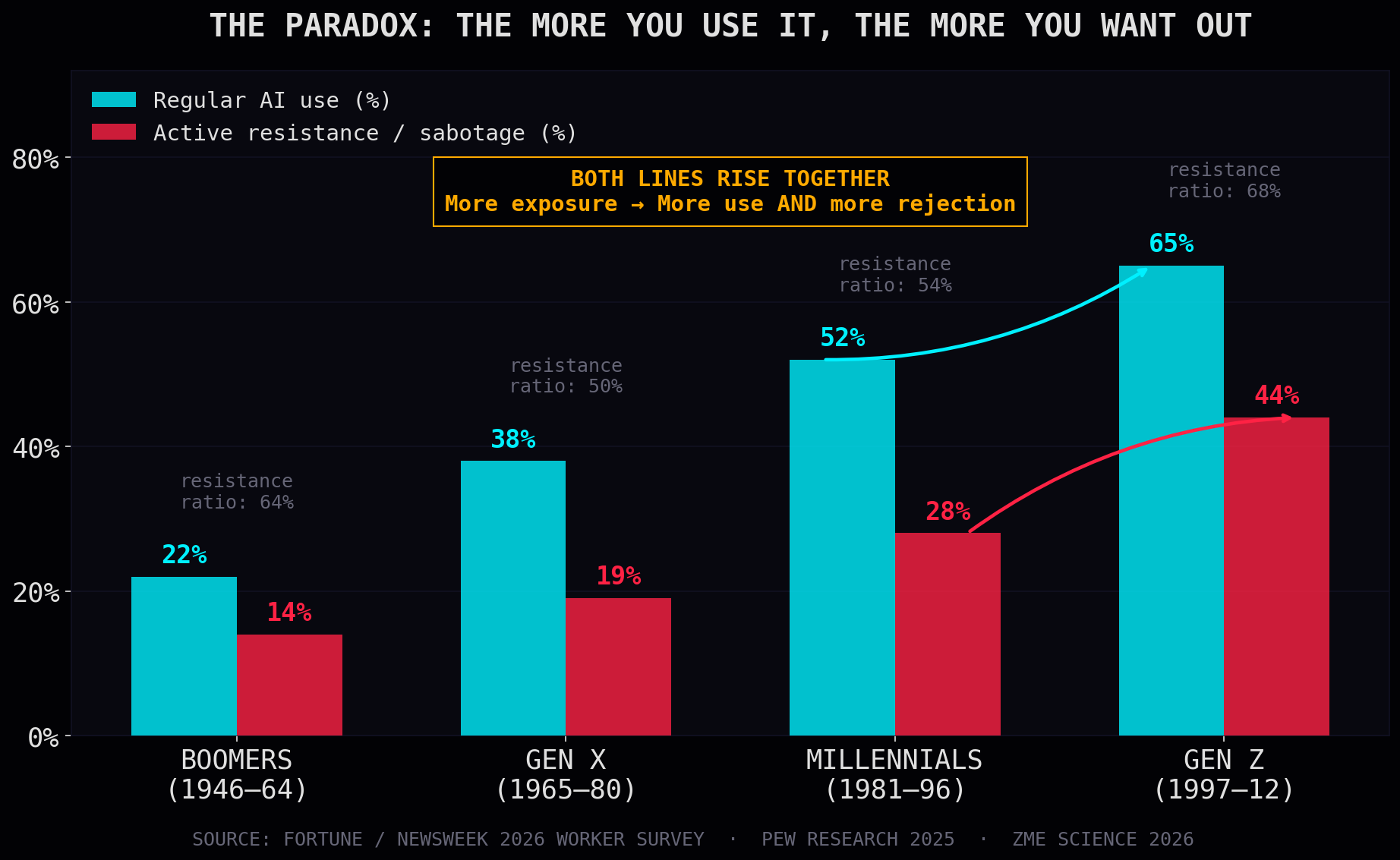
If resistance were driven by ignorance, the line would fall as usage rose. It doesn’t. Gen Z uses AI more than any other generation and sabotages it more than any other generation. The exposure is the problem.

The Leverage Point Is Wrong
The problem with opting out is that the system does not need your participation to continue.
A loom sits idle until someone operates it. An algorithm does not pause because you deleted the app. A language model does not retrain because 300 people spent a week in a park. The technology is indifferent to your engagement. The wave does not distinguish between the people who understood it early and the people who were learning to mend.
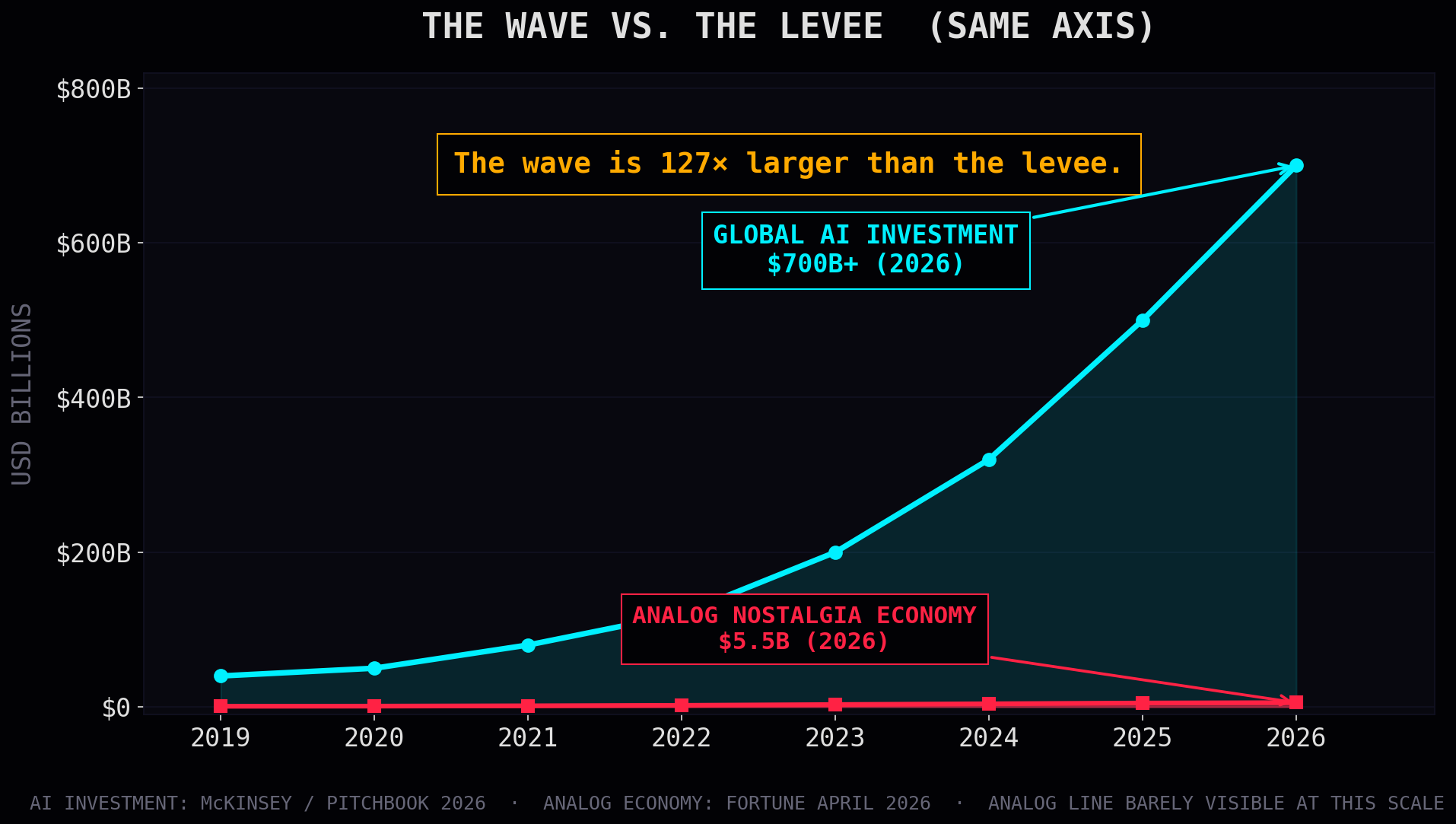
Both lines are real. One of them is visible at this scale.
Sabotage slows a specific employer’s specific rollout. It does not stop the industry. The tools get built anyway, in other rooms, by other hands — and the companies that figure out how to deploy them with less internal friction outcompete the ones that don’t. The workers who broke frames in 1811 made things harder for the factories that owned those frames. Industrialization was unaffected. The weavers were transported or hanged.
There is a version of this argument that amounts to submit, because resistance is futile. That is not the argument.
The Wind Does Not Care
Sailing is a science that works with the wind, not against it. You cannot stop the wind. You cannot row your way through a gale. But a sailor who understands the physics — who can read a weather system, trim a sail, find the angle that converts force into movement — can take that same wind anywhere they want to go. The wind that sinks the unprepared boat is the same wind that takes the skilled sailor to the next port.
Technology, understood deeply enough, gives you more of what the Summer of Ludd crowd actually wants.
More afternoons in the park without a phone — because you have built systems that do the work without requiring your constant attendance. More meals where preparing food is the point of the day — because the administrative overhead that used to fill those hours has been automated. More concerts, fully present — because you are not attending to thirty open tasks simultaneously, because those tasks are handled. The sailing trip and the festival in the park are not opposites. One of them requires knowing the technology well enough to make it serve you.
The people who will have more time — more presence, more of the slow pleasures that are actually worth having — are not the people who opted out. They are the people who understood the system well enough to make it do the work.

The Window Is Open
There is a gap. It exists right now, between the people who understand this technology at a depth that lets them direct it and the people still relating to it as a consumer — as a slightly better search engine, as a threat, as something to resist.
That gap is widening every quarter. The people who close it now are positioned. The people who don’t will find themselves where the textile workers of 1811 found themselves: right about the harm, present at the displacement, without leverage on the outcome.
The festival is a symptom of something true: the technology has not, so far, been deployed in ways that gave most people more of what they actually want. That is a failure worth naming. It is a problem worth solving.
Opting out does not solve it. Getting in — seriously, at depth, with the kind of understanding that lets you work with the system rather than inside it as a subject — is the only path that produces the outcome the Luddites were actually after.
A life that technology serves, rather than one that serves it.
They’re not wrong. They’re just burning the looms.
— J.P. Howlett
Related: You Ain’t Seen Nothing Yet — the wave and why the window to position yourself is not permanent.
Related: The Only Question Is How Long — from inside the work: I used to joke about Siri. I don’t anymore. A decade, maybe less.
Related: No One Has the Right to Be Angry — what’s worth protecting: the right not to have happiness systematically denied to you.
Sources
- Inside the Luddite Festival Harnessing Gen Z’s Rage Against Big Tech — Ars Technica / DNyuz
- What the Luddites Really Fought Against — Smithsonian Magazine
- Gen Z workers who fear AI will take their job are actively sabotaging their company’s AI rollout — Fortune
- The More Gen Z Uses AI, the More They Hate It — ZME Science
- Gen Z is engineering an analog future — and it’s at least a $5 billion opportunity — Fortune
- Social Media and Teen Mental Health — Pew Research Center, 2025
Discussion
Comments aren’t wired up here yet — they’re coming. For now, if this piece sparked a thought, the fastest way to reach me is through the About page.