
The Global Fund was built this way. So was GAVI. So was GPS. Government and private capital working together toward a defined public good — a framework, a mandate, a measurable outcome. Public-private partnerships, built right, have changed the world.
So this is not an argument against public-private cooperation. It is an argument about what the OpenAI equity deal actually is — and what it isn’t.
What Works
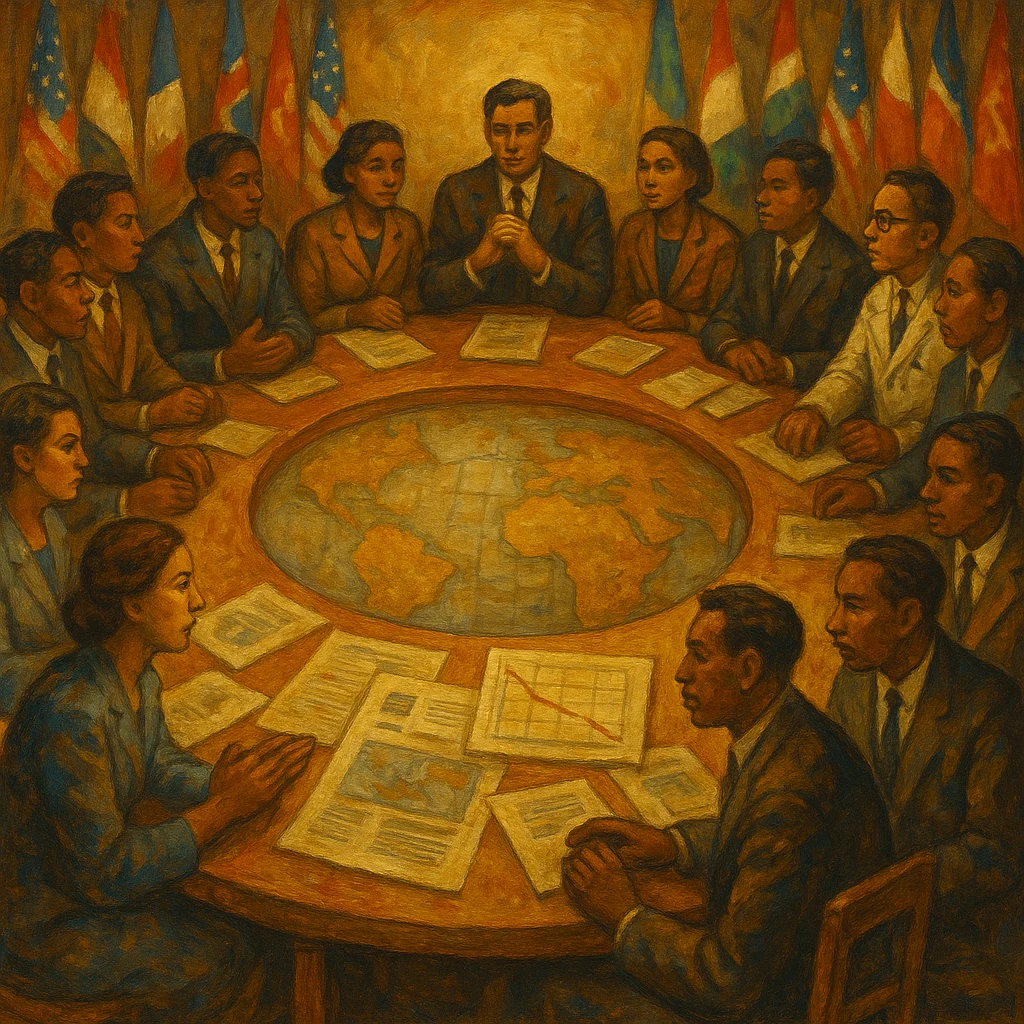
The Global Fund was established in 2002 to combat AIDS, tuberculosis, and malaria. Its board has thirty-nine members: governments, civil society organizations, private donors, representatives from affected communities. Its mandate is explicit: immunize these populations, treat these conditions, spend these dollars in public health systems that can be audited independently. It has channeled over $60 billion into programs that can be measured, criticized, and reformed.
GAVI — the vaccine alliance — shares that structure. Governments fund it. Pharmaceutical companies participate. The public outcome is specified in advance: vaccines delivered to children who would otherwise not receive them. Multiple stakeholders. Real accountability.
DARPA funded the research that became GPS. The government defined the capability it needed and put money toward achieving it. Private contractors executed the work. The public got navigation technology that now runs inside every device on the planet. The government had a mission. The mission was completed. The result was opened.
These partnerships share an architecture: a defined public problem, multiple stakeholders with accountability to each other, and a specified outcome that can be evaluated independently of whether the private partner made money.
That architecture is the whole point. It is what separates a partnership from a transaction.
What This Deal Is
OpenAI proposed giving the U.S. government a 5% equity stake — roughly $42.6 billion at its current $852 billion valuation. Sam Altman’s framing: sharing the upside of AI with the American public. The vehicle: a sovereign wealth fund that other AI companies — Anthropic, Google, Meta — would also contribute to.
No other company has agreed. The deal is bilateral: one government, one lab.
The headline on CNBC put it plainly. OpenAI’s pitch “came after more than a year of talks” and was designed “to address political blowback.”
That sentence should stop you cold.
This was not designed to solve a public health crisis. It was not designed to build infrastructure, achieve a defense capability, or extend a public good to people who couldn’t otherwise access it. It was designed to quiet critics in Washington.
The government is not being hired to accomplish something. It is being offered a financial stake in a private company’s success — with no board representation, no governance rights, and an explicit agreement to vote with management on shareholder matters.
There is no defined public problem. There is no specified outcome. There is no independent accountability mechanism. There is a check.
This is not a partnership. This is a payment.
The Legal Version of a Bribe
There is a word for what happens when something of value changes hands in order to influence the behavior of an institution that is supposed to act in the public interest. That word is bribery.
The federal statute requires the payment to go to an individual official. That is why what Altman has done is not a crime. The equity flows to the government as an institution, not to any named person. The technical condition for prosecution isn’t met.
But the mechanism is identical. Something of value — $42.6 billion — changes hands. The institution receiving it acquires a financial interest in the success of the payer. The institution’s incentive to scrutinize the payer is diluted in exact proportion to the size of that interest. The outcome — regulatory alignment, reduced scrutiny, a quieter Washington — is precisely what the payment was designed to purchase.
Altman has found the legal version of a bribe. That is not exculpatory. It is the indictment.
What makes this more dangerous than ordinary corruption is that it’s structural and permanent. A bribe is a one-time transaction that can be prosecuted and reversed. A financial stake is an alignment baked into the institution itself, compounding every quarter, growing more entrenched as the company’s valuation rises. The larger OpenAI gets, the more the government benefits from its continued growth, and the harder it becomes to regulate it.
The law does not have a word for this yet. It should.
The Conflict Is Already Live
You don’t have to theorize about what happens when a government holds equity in a company it’s supposed to regulate. The Trump administration took a 10% stake in Intel in August 2025 — $8.9 billion converted from CHIPS Act grants to equity. Passive ownership, the agreement said. No board seat. Votes with management.
Senator Elizabeth Warren asked the obvious question: Intel can still move its factories overseas. The deal that was supposed to guarantee domestic semiconductor manufacturing — the stated national security rationale — doesn’t actually require Intel to manufacture domestically. The government’s financial interest and the public interest it was supposed to serve are already pulling in different directions.
The chip export control problem is more structural. The Commerce Department sets rules about which chips can be sold to China. It now holds 10% of Intel’s equity. If Intel develops a product China wants to buy, the government’s financial interest says: approve the sale. National security says: block it. Those two imperatives now live in the same institution, on the same balance sheet, with no framework to adjudicate between them.
AI safety creates the same tension at higher stakes and faster velocity.
A government that profits from OpenAI’s growth has a financial interest in not constraining OpenAI’s growth. Safety interventions, liability rules, compute restrictions, export controls — every tool in the AI governance toolkit has a cost to OpenAI’s valuation. The institution being asked to wield those tools now has a reason not to.
This is not a conspiracy. It is an alignment. Everyone agrees because everyone benefits from agreement.
Eisenhower Said This Out Loud
Dwight Eisenhower’s farewell address in 1961 is remembered for coining the phrase “military-industrial complex.” The full warning is less often quoted:
“In the councils of government, we must guard against the acquisition of unwarranted influence, whether sought or unsought, by the military-industrial complex. The potential for the disastrous rise of misplaced power exists and will persist.”
He was describing a structural problem, not a conspiracy. When the institutions that develop powerful technology and the institutions that are supposed to govern it share the same financial interest, the governance function degrades — not through corruption, but through alignment. The oversight that was supposed to be adversarial becomes collegial. Everyone is on the same team. No one is watching.

The military-industrial complex did not require malicious actors. It required that defense contractors, defense agencies, and the legislators who funded both of them all benefit from the same outcomes. That alignment is still with us sixty-five years later, baked into procurement structures, revolving-door career paths, and defense budgets that no administration has successfully reduced.
It was not the last time this structure appeared.
Thirty years after Eisenhower’s warning, a different alignment took hold: private prison companies — Corrections Corporation of America, GEO Group — built facilities and lobbied aggressively for mandatory minimum sentencing, three-strikes laws, and the criminalization of nonviolent offenses. Their revenue depended on occupancy rates. The legislators setting those rates had financial relationships with the same industry — through the American Legislative Exchange Council, through campaign contributions, through the revolving door between corrections departments and private prison boards.
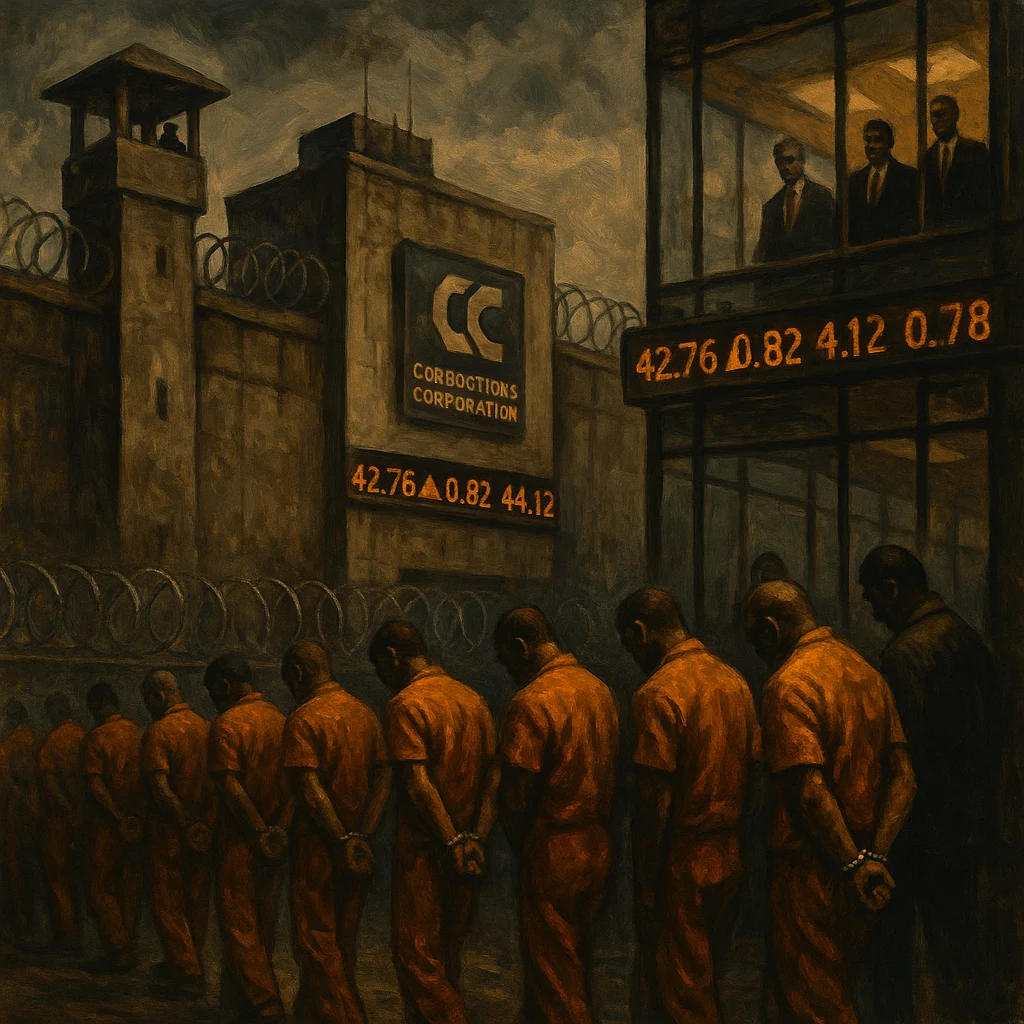
The result is in the statistics the United States still cannot explain to the rest of the world. A country with 4% of the global population holds roughly 20% of its prisoners. The prison-industrial complex did not require anyone to be corrupt. It required alignment. When the profitability of an industry depends on a government policy, and the policymakers have a financial relationship with that industry, the policy tends to stay in place long after its social cost is obvious to everyone outside the alignment.
Three structural examples. Three different industries. One pattern.
We are now building the AI-industrial complex. OpenAI and the U.S. government are becoming financially aligned. No other country has a seat at the table. No multilateral framework defines the terms. No independent body specifies what “public benefit” means or measures whether this arrangement delivers it.
The Eisenhower warning was issued sixty-five years ago. We are doing it again. The industry is different. The stakes are larger. The window to wire accountability into the architecture is the same window we always have: before the architecture is finished.
What a Real Framework Looks Like
The alternative isn’t refusing to cooperate. The Global Fund cooperated. GAVI cooperated. The interstate highway system was built through cooperation between government and private capital.
The alternative is a framework — multilateral, transparent, with defined public outcomes and accountability mechanisms that exist independent of whether any particular private partner prospers.
AIGCSEP — the AI Governance and Credential Security Exchange Protocol, submitted to the IETF in June 2026 — is a proposal in that direction. Not a company. Not a bilateral deal. A protocol: a set of rules that any government, any lab, any system can implement and verify. Cryptographic constraints enforced at every gateway, with credentials held in human custody and authority mapped to existing governance structures.
The point of a protocol is that it has no financial interest. It cannot be bought out. It does not benefit from alignment. It enforces what agreements cannot — not because the parties are trustworthy, but because the math runs regardless of whether they are.
A government that signs the Covenant doesn’t own a piece of an AI company. It owns a seat at a table where the rules apply to everyone, including the companies and governments that built the table.
That is what a public-private partnership in AI governance actually looks like.
The Question That Exposes the Deal
Every successful public-private partnership in history began with the same question: What is the public problem we are trying to solve?
The Global Fund answered it: AIDS, tuberculosis, and malaria kill millions who do not have to die.
DARPA answered it: we need to navigate from satellites.
The OpenAI equity deal does not answer it. “Sharing the upside of AI” is not an answer — it is a justification for a financial arrangement that was designed, in Altman’s own positioning, to address political blowback. The government is not solving a problem. It is being compensated for agreeing not to create one.
OpenAI is buying something no company should be permitted to purchase: the credibility of the institution that is supposed to hold it accountable.
One government. One lab. One deal. No protocol. No other stakeholders. No public outcome specified. No independent accountability.
That is not a partnership.
It is a conflict of interest with paperwork.
— J.P. Howlett
Related: You Ain’t Seen Nothing Yet — the tidal wave of AI disruption, why the governance window is open now, and why it won’t stay open.
Related: This Is What Un-Governed AI Looks Like — why financial stakes can’t substitute for protocol: what a cryptographic accountability layer actually changes.
Sources
- OpenAI proposes U.S. government own 5% stake to address political blowback — CNBC
- OpenAI Proposes Giving the US Government a 5% Stake — Bloomberg
- U.S. government takes 10% stake in Intel, as Trump expands control over private sector — CNBC
- Warren Presses Commerce Secretary on Trump’s Deal to Give the U.S. 10% Stake in Intel — U.S. Senate Banking Committee
- The U.S. government is taking a stake in Intel. It’s rare — and it has some risks — NPR
- Understanding Federal Equity Investments in Strategic Companies — CSIS
- Public–private partnership — Wikipedia
- Corporate capture of development: Public-private partnerships and global resistance — Eurodad
Discussion
Comments aren’t wired up here yet — they’re coming. For now, if this piece sparked a thought, the fastest way to reach me is through the About page.