
Ben Bernanke just joined Anthropic’s Long-Term Benefit Trust. The man who chaired the Federal Reserve through the 2008 crisis, who has spent a career thinking about systemic risk in tightly coupled systems, is now helping govern frontier AI development.
I want to be careful here. I am not saying Ben Bernanke is unfit. I am not prejudging a decision before the man has had a chance to perform. I wouldn’t want that done to me — I have experience in my background that people might not immediately see as an asset, but it is. Context and trajectory matter more than resume line items.
What I will say is this: the organization he came from is not known for transparency. And when I hear something that sounds like Fed-style institutional thinking being imported into AI governance, some red flags go up.
The Case For This
Let me be honest about what Bernanke actually brings.
AI is a deeply economic thing. The compute costs are staggering and accelerating. The market dynamics are unlike anything we have seen — winner-take-all network effects, massive capital requirements, a race dynamic that punishes caution. The systemic risk questions are real: what happens when a handful of companies control the infrastructure that everything else runs on? How do you manage cascading failures in systems that are tightly coupled in ways nobody fully understands yet?
These are macroeconomic questions. Bernanke has spent his career on exactly this class of problem. He has been in the room when decisions with civilizational consequence had to be made under uncertainty, with incomplete information, on a timeline that did not allow for perfect analysis.
Anthropic is a private company. They have every right to structure their governance however they see fit. Maybe macroeconomic experience is exactly what they need. I am genuinely open to that.
The Part That Makes Me Uneasy
The Federal Reserve was designed at Jekyll Island in 1910. A group of bankers and senators met in secret — traveling under assumed names, departing separately so no one would know they were together — to design what they would sell to Congress as a public central bank. The result was a body with the appearance of independence and the function of a state instrument. Unelected officials with the power to expand or contract the money supply, to choose which institutions survive when the system seizes up.
They call it monetary policy. What it is, is price-fixing at civilizational scale, conducted in private, by people nobody voted for.
The books always balance. Economic principles are as immutable as physics. You cannot print your way to prosperity — you can only decide who pays the bill and when. Quantitative easing enriched asset holders and punished savers. Near-zero rates for a decade inflated every asset class, and then the correction came, as it always does.
The institution produces people who are often brilliant, operating with enormous confidence, inside a structure that is not accountable to the public it affects. That structure is what concerns me — not the individuals it produces.
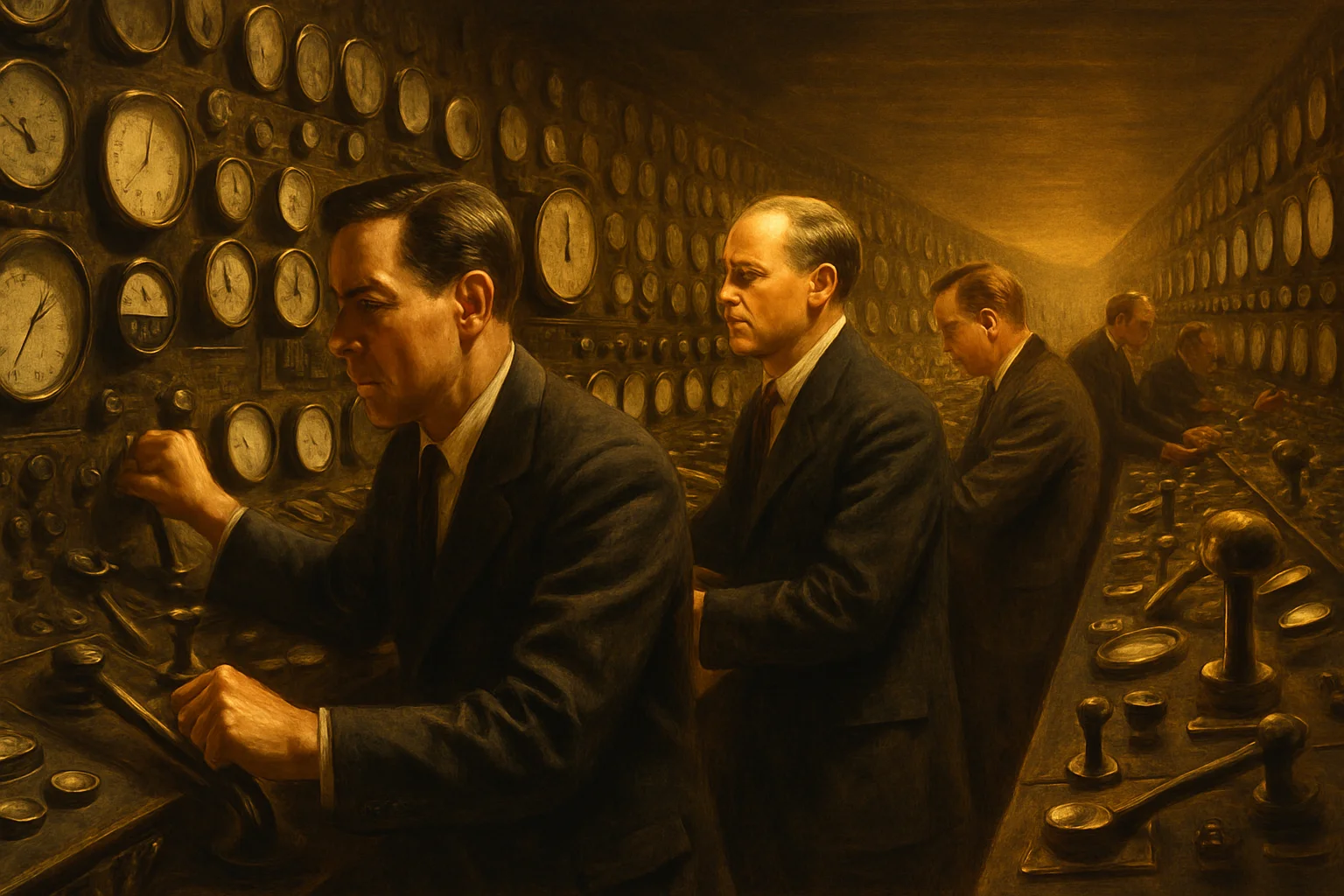
What I Am Actually Watching
My concern is not that Bernanke specifically will do something wrong. My concern is whether the habits of the institution he came from — the comfort with closed-door decisions, the assumption that credentialed experts should make choices on behalf of people who cannot evaluate those choices — travel with the appointment.
AI governance needs people who have managed systemic risk at scale. It does not need the assumption that managing systemic risk requires opacity.
Those are two different things. The first is an argument for this appointment. The second is a reason to watch it carefully.
What Open Governance Actually Looks Like
There is a document currently before the IETF. It is called draft-howlett-aigcsep-00. It proposes a standard — an open, technical protocol — for how AI systems communicate, what they disclose, and how they are governed. Not a board. Not a trust. A spec.
A spec is transparent. Anyone can read it, challenge it, improve it, implement it, or refuse to. The standards process is public. The thing that governs you is the thing you can see.

That is the model I believe AI governance needs. Not because boards are inherently corrupt, but because the questions AI raises are too consequential to be answered by people who are not accountable to the rest of us.
Bernanke may prove to be exactly the right voice in that room. I hope he does. But the right voice in the wrong room is still the wrong room.
The closed room is the problem. Not the man.
— J.P. Howlett
Related:
- The Covenant Protocol — what open AI governance actually looks like
Sources
- Ben Bernanke Joins Anthropic Oversight Trust — Anthropic
- The Secret Meeting on Jekyll Island — Federal Reserve History
Discussion
Comments aren’t wired up here yet — they’re coming. For now, if this piece sparked a thought, the fastest way to reach me is through the About page.