
I’ve spent three articles building the case for the worst-case outcome. The dam breaking and the flood it releases. Forty years of ratchet with no next step. The structural irony of needing socialism to save capitalism, and the three walls that make it nearly impossible to administer in time.
Let me tell you what the counter-argument actually is.
Not the reassuring version. Not “technology always creates new jobs” — we demolished that in Part 2. Not “the market will find a way” — Part 3 showed why it structurally can’t. The actual counter-argument, with its actual weaknesses, because you deserve the honest version.
Space
Take the space industrial complex seriously for a moment.
SpaceX is real. Starship is real. The economics of orbital launch are collapsing — cost per kilogram to orbit has fallen from $54,000 (Space Shuttle) to under $2,000 (Falcon 9) to a projected $100 or less with Starship reusability at scale. Asteroid mining has a genuine economics: the asteroid belt contains mineral wealth that dwarfs Earth’s entire GDP by orders of magnitude. Orbital manufacturing has physical advantages — zero gravity, hard vacuum, unlimited solar power — that are not achievable on the surface.
Frederick Jackson Turner declared the American frontier closed in 1893. His thesis: the frontier had been the pressure valve that absorbed restless labor, ambitious capital, and political energy for a century. Its closure, he argued, would force a reckoning with the concentrated power and economic inequality that industrial capitalism was producing. He was right. The Progressive Era, the labor movement, the New Deal — all of it traceable partly to the closure of the outlet.
A new frontier opens the valve. The historical case is real.
The problem is the timeline.
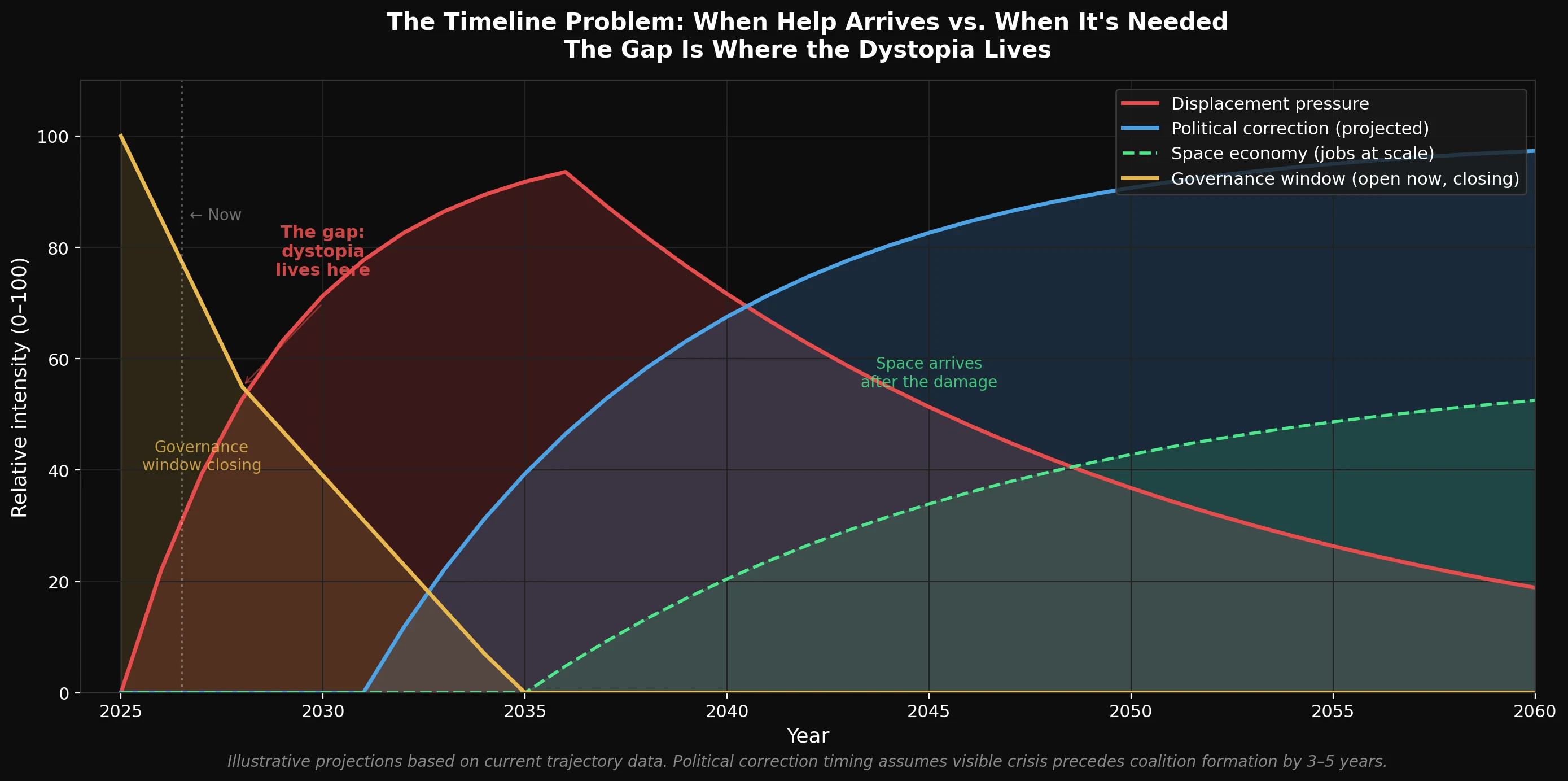
The displacement wave hits in 5 to 10 years. Space industry generating employment at meaningful scale — not thousands of engineers, but millions of workers — is 20 to 30 years away at optimistic projections. The gap between those timelines is where the dystopia lives. Space doesn’t arrive wrong. It arrives late.
The Arts Economy
When I raised the possibility — people spending their days preparing meals, pursuing the arts, engaging in craft — I was half-laughing at myself. Let me stop laughing long enough to examine it.
The activities most resistant to AI automation are precisely the ones most deeply human: physical craft that depends on embodied skill and sensory judgment, care work that requires genuine emotional presence, creative work that draws on lived experience no model can replicate, food prepared with attention and love rather than optimization. These are not marginal activities. They are the things human beings have done for each other since before there was an economy to transact in.
The dystopia version of this future is easy to describe: arts and crafts are what rich people do in their leisure time. The displaced knowledge worker doesn’t get to spend their days making bread and pottery — they compete for whatever low-wage service jobs AI hasn’t yet taken, while the wealthy patron class enjoys the artisanal products of a leisure class that can’t afford to be leisured.
The utopia version requires one thing: the redistribution floor. A guaranteed income sufficient to survive on frees people to pursue non-market activity. The technology to make survival cheap exists. AI-driven abundance genuinely does reduce the cost of food, energy, healthcare, and manufactured goods. In a world where the floor is funded, the arts economy is not a fantasy. It’s what you get when you remove the requirement that every human activity must generate market income to justify itself.
The arts economy is real. It just lives on the other side of the redistribution mechanism that Part 3 said is nearly impossible to build in time.
The Displacement Coalition
Here is the strongest counter to the dystopia default, and it’s the one I want you to sit with.
Every prior technology displacement wave hit workers who were politically weak relative to the capital that displaced them. Factory workers in the 1980s had declining union density, lower civic participation, and less political organization than the executives and shareholders who made the decisions. Service workers in the 1990s had less. Gig workers in the 2010s had less still. The political economy of displacement consistently favored capital because the displaced had less power to mount the political response.
The knowledge workers being displaced next are different.
They are lawyers, accountants, financial analysts, marketing directors, mid-level managers, consultants. They vote at high rates. They have existing political networks. They understand the economic arguments being made about them. They have the organizational skills that come from years of professional life. They are not easily distracted by culture war misdirection — or at least less easily than workers whose economic anxieties were more diffuse and whose information environments were easier to manipulate.
When a 48-year-old financial analyst who voted Republican in every election since 1996 loses their job to an AI system and discovers that the party they’ve been voting for spent forty years building the policy environment that made it possible — that is a political event. Multiply it by millions of people in the same category, arriving at the same realization in the same 24-month window, and you have a political coalition that has never existed before: high-civic-participation, high-income, high-education workers whose economic interests have been betrayed by both parties’ accommodation of capital over labor.
That coalition could force redistribution faster than the historical pattern suggests. It could elect people who mean it when they talk about automation taxes and worker protections. It could move faster than the three walls — timing, mobility, lobbying — have historically allowed.
This is the strongest reason I might be wrong about the default.
The Historical Record
The industrial revolution was genuinely hellish. Not metaphorically. Children in textile mills. Sixteen-hour days. Life expectancy in industrial cities lower than in rural areas. Urban disease. Immiseration at a scale that shocked the writers who documented it — Dickens, Engels, Mayhew. The dystopia was real.
And then: labor unions. The progressive era. The New Deal. The GI Bill. The postwar middle class. The 20th century, for all its wars and horrors, produced the broadest distribution of material prosperity in human history. The hellscape of the industrial revolution eventually produced the correction.
The historical record on technology displacement is: it gets worse before it gets better, the transition period is genuinely terrible for the people caught in it, and then it gets better.
The question for AI is not whether it eventually gets better — history suggests it will. The question is how long the transition takes, how many people it grinds up before the correction arrives, and whether the political response comes before or after the conditions for demagoguery are established. Weimar didn’t fail because Germans were uniquely susceptible to fascism. It failed because the economic crisis preceded the political response by long enough to make the bad option seem like the only option.
The Narrow Path
So: tell me I’m wrong.
The honest answer is that I can’t, fully. The default path ends in something that looks more like dystopia than utopia — not permanently, but in the transition period, for the people caught in it, badly. The space economy arrives too late. The arts economy requires the floor that the political system is unlikely to build in time. The historical record says corrections come, eventually, at a cost.
But here is what is different this time, and it is the only thing that changes the default:
The technology itself is still being built.
Every prior technology disruption was over before the governance response began. Steam engines were running factories before anyone thought seriously about factory conditions. The internet was restructuring the economy before anyone wrote meaningful platform regulation. The financial instruments that produced 2008 were already collateralized and sold before regulators understood what they were.
AI is not over. It is being built now, by people who know what it will do, in systems whose architecture is still being designed. The window where governance can be wired into the substrate — not bolted on afterward as an external constraint, but built into the foundation as an internal structure — is open.
The Covenant is that architecture. Not a product. Not a company. A protocol: every AI action signed, attributed, and traceable; credentials held in human custody; authority mapped to existing governance structures. Not because the AI systems are untrustworthy, but because governance that depends on trust isn’t governance. It’s hope.
What does AI governance have to do with economic redistribution? Everything.
If the systems doing the displacing are ungoverned — operating as black boxes whose behavior can’t be audited, whose decisions can’t be traced, whose impacts can’t be measured — then redistribution is legislatively impossible. You can’t tax what you can’t count. You can’t build displacement insurance around events that aren’t reported. You can’t hold companies accountable for labor impacts they aren’t required to disclose.
If the systems are governed — operating within a protocol that requires audit trails, that makes AI-driven decisions attributable and verifiable — then redistribution becomes technically enforceable rather than just politically aspirational. An automation tax becomes something you can actually implement because the data it requires exists and is verifiable. Displacement reporting becomes mandatory because the protocol requires it. The three walls don’t fall — but the timing wall gets shorter, because the crisis is visible earlier, and the lobbying wall gets lower, because the data that companies have been hiding becomes part of the public record.
The governance window is open. The machine is substantially writing its own successor — Anthropic said it publicly, roughly 80% of each new Claude written by the previous Claude. The portion of the stack that humans author is shrinking. The window doesn’t stay open indefinitely.
Am I Wrong?
Tell me I’m wrong. Tell me the political coalition forms in time. Tell me the space economy generates the employment relief before the displacement wave peaks. Tell me the redistribution mechanism is built before the crisis rather than after it. Tell me the historical pattern of technology-driven correction happens faster this time because the coalition is stronger and the data is better and the governance response is more sophisticated.
I want to be wrong. Not as a rhetorical gesture. Actually.
The two-door problem I’ve been writing about for years is real. Post-scarcity or neo-feudalism. The technology that produces either one is the same technology. The difference is governance — and specifically whether governance gets built into the architecture before the architecture is finished.
That window is open now. The work being done on it — the protocol, the standards, the governance arguments — is not abstract. It is the narrow path. It is the thing between the default and the alternative.
Dystopia is the path of least resistance. It doesn’t require any decisions. It happens if we do nothing differently than we’re already doing.
The other door requires decisions. Specific ones, made soon, by people who understand what they’re deciding.
You’re one of those people. So am I.
That’s not nothing.
— J.P. Howlett
The Econolypse series:
- Part 1: When the Levee Breaks — the dam, the indicators, when it gives
- Part 2: The Demand Side Doesn’t Forgive — forty years of ratchet, three piggy banks
- Part 3: Socialism Saves Capitalism — the structural irony and the three walls
- Part 4: Tell Me I’m Wrong — this piece
Related: You Ain’t Seen Nothing Yet — the tidal wave, the two doors, and why the window matters.
Related: Anthropic Controls the Switch — what ungoverned AI infrastructure looks like in practice.
Related: The Only Question Is How Long — the personal version of this argument. From inside the work, not from theory.
Sources
- The Significance of the Frontier in American History — Frederick Jackson Turner, 1893
- Starship — SpaceX
- Unconditional Cash Transfer Research — OpenResearch / GiveDirectly
- Navigating the Jagged Technological Frontier — BCG / Harvard Business School, 2023
Discussion
Comments aren’t wired up here yet — they’re coming. For now, if this piece sparked a thought, the fastest way to reach me is through the About page.